Thesis Statement

Computational Symbioses – Back to the Roots

Humanity as a species is situated in a big system, the natural ecosystem. In the evolution of human kind, we developed technologies and with it tools in order to fulfil our needs and desires. Through scientific research, we found processes to develop materials in order to produce even more sophisticated technologies. By using such sophisticated technology, we separate ourselves from the natural ecosystem. Humanity and the natural system do co- exist but are no longer connected.

This situation drives the natural system getting out of balance and therefore threatens to collapse as the way it is right now. We as humans are dependent on nature, since it delivers us essential resources for our existence. If we want to exist longer in this natural ecosystem, we must get rid of isolated technology. We must find symbioses with nature to interact with in order to keep the natural circulation in balance.

In the past few decades, we discovered the power of digitalization and with it, the interaction with computational systems. Nowadays, the field of Human-Computer- Interaction is ubiquitous, and their innovations must not be reversed. Humanity’s benefits from it are enormous, but in regard to the natural system, it is not incorporated.
Therefore, we have to shift from interacting with isolated computational systems to interacting with the big system, nature. A new field of research emerging from HCI needs to be proposed: Human-Nature-Interaction.

In my bachelor thesis, I want to rethink ubiquitous processes of our society by attempting to get them more connected to natural symbioses. I see the discipline of Human Computer Interaction as very important, since it researches psychological aspects of human interaction with external, dynamic objects. There I see an interesting crosslink, I am eager to deep more into.

What is the topic/issue/phenomenon that you aim to investigate?

I believe, that natural processes are the non-plus-ultra in terms of efficiency and sustainability, because of its evolutional development throughout the past millions of years. I think, the computational power of nature exceeds the capabilities of computers as we know them by far. In order to benefit from this skill, it requires investigation in how we as humans could interact more with nature and how nature could interact with us.

Is it a problem that you want to solve or an opportunity that presents itself?

In general, I am looking for natural phenomena, that can deliver us information. To make this clearer I want to use the following example as clarification: Before weather forecasts existed in television and newspapers, farmers, who were dependent on the weather needed another way to get information. In order to be prepared to the changing weather conditions, they used to investigate changing behavior of the nature, like for example low flying swallows, which indicated an area of low-pressure depression and therefore a high probability for rain. The in German called “Bauernregel” shows a nice example how people used natural occurrences as an information system in earlier days. I am interested in investigating more in such interactions and compare them to HCI-Theory.

08.12.2020 Theory 5 Andreas Bütler

What research questions could you ask or what statements could you make?

Can we design symbioses, or can we just find them? How could we find human nature symbioses and how could we interpret its outcome? How do we communicate with natural material? How can we get rid of the attempt, wanting to control the natural systems, rather than being part of it?

Based on these questions, I would like to quote from a documentary about permaculture: “The more interventions you make in nature, the more mistakes you’re likely to make”

What methods would you use to answer the questions or prove your hypothesis?

There are many experts that have much more knowledge in the various fields of interest I mentioned. It would be interesting to interview them or maybe even get them together to discuss my thesis at one table. Since my topic of interest is not only a technical discussion but also a societal, a participatory design approach is needed to some extent. For me, participatory means involving the concerned parts into the design process. This means not only humans should be participants in this process, but also nature itself.

Therefore, I see an experimental, hands-on approach really important in this field, since I want to tackle a problem in the real world.
Nowadays advanced technology often learns from biologic patterns. I think taking the bionic approach in my research would be the right way to start with in order to find interesting natural phenomena that could be valuable for further investigation.

What is your motivation for investigating this topic?

Since several years, I think especially in my generation, people are starting to question how we are living and how we are using our resources, which are directly bound to the natural system. Sustainability is starting to get a trend on a global scale.
I would describe myself as an optimistic person, so I am willing to search for solutions, be it on a social or technological level.

What makes you a suitable investigator?

As mentioned in the previous paragraph, this discourse happens on a global scale. In my opinion, especially designers have the skill to see the big picture and are therefore able to make new connections in order to find creative solutions. I see myself, as an interaction designer, capable to do exactly that without losing track. With the right knowledge and feel for technological, social, as well as philosophical aspects.

What difference would you make compared to prior projects who addressed this topic?

I would definitely not want to offer one finite, world healing solution. I am fully aware that I am not able to rethink the whole world. I think in this field, it is very important to not judge the actual state, but rather offer interesting solution proposals that are fun, beneficial and motivating to develop for the future.

What contribution do you hope to make?

In general, I want to combine two favorable and necessary entities for human kind. With the outcome I intend to deliver a new understanding for natural processes to a broader range of people. Often, technology and nature seem to complement each other. I want this to prove false through a proposal of new possibilities through combining them.

Bachelor Thesis Nightmare

When thinking about future projects it makes sense to not only set goals where one wants to go, but also think about scenarios that should be avoided. In the past class, we talked about what possible events of disappointment, as well as situations where my bachelor would not change anything.

What would be a thing that would disappoint you in your bachelor thesis?

I think my biggest fear in my bachelor thesis to miscalculation in terms of time. It would disappoint me if I set myself too many focus points, which I would not be able to finish. Instead, I would start with everything and end up with a lot of unfinished experiments without any results to work with.

I think it is important for me to have an end product in the end of my process. Doesn’t matter if it is only an exhibition piece that shows certain interesting aspects or a real product in the end. A nightmare for me here would be if I don’t manage to produce something in the end or produce something that has no meaning for the “audience”.

Another point is that I am kind of afraid, to take a scientific method or technology as a base for my work, which then proves to be completely wrong and would therefore question my whole work. I hope that I’ll never come to a point where a need to admit that my work was complete nonsense. This would be the biggest nightmare for me.

Can you imagine a situation where your work doesn’t change anything?

Of course, one situation would be if I would do my work and realise in the end, that exactly the same thing has already be done several times. Actually, this happened in this course already when I was trying to think about a topic of interest one has never thought of. After talking to my classmates about it, I got told that this concept was examined as a bachelor topic some years ago. As a conclusion I would say the best solution to avoid such a situation is talking to as many people as possible, who might know more than you.

As already mentioned I think a very important aspect in my thesis will be the storytelling aspect. If I don’t manage to make sense out of my work, nobody will recognise connections and the contribution, and will therefore not acknowledge the value of it. If this does not happen my work would not change anything.

Past Bachelor Thesis

A work I think failed: pol-kontrol.ch

I think the topic that was chosen for the research in the beginning was really interesting. As far as I understood it from the presentation it was about the notion of deja-vu’s. But what I didn’t get was the connection between the research and the end project, a website, in the end. This was pretty disappointing for me. But I have to say one must take the whole situation of the pandemic in consideration, which made the whole process enormously difficult.

A work I succeeded: Tales of Arid’Nu

In this work I really liked how an abstract topic was connected to a very beautiful and aesthetic exhibition piece in the end. This exhibition piece showed a complex topic and path of thinking in a simplified way. For me personally, the project had the right mixture of theoretical thinking, future scenarios, technology, physical objects and aesthetics, which impressed me a lot.

Further thoughts and questions after the session in class

  • What can you bring as an interaction designer?
  • not reach too far; be aware (identify) of your skillset to not overwhelm yourself in that short timeframe
  • Task: make post-it wall of your skillset (strengths)?¿

Bachelor Thesis Dream

Dreaming is a nice way to figure out expectations and setting big goals for the future. It is sometimes useful to think big, although these goals might not be fulfilled completely. In order to figure out what I want for my thesis, I imagined the optimal outcome of my thesis.

Personal relevance

I think the most important thing for me is to do something for my thesis which is relevant for me and interests me. I personally see this time of work as a chance to do something that I like and therefore will have fun. I’m also really looking forward figuring out my own way of working and creating kind of my own schedule.

Showing my skillset

I’ve learnt so may things in the past years. It would be a real pity to not show my skills in my work. Therefore, I see my bachelor thesis also as kind of an exhibition piece of myself for all the people I know (parents, relatives, friends) but of course also possible employers or business partners. When I talked to a co-student from visual communication about the thesis recently, he claimed that the bachelor thesis in a design field will define the next five years of your career. One could argue about the time frame that is mentioned, but I believe that there is some truth behind that sentence.

Creating the wow effect

One big aspect I want to reach in my bachelor work is creating some sort of a wow effect. I think it is important for me to get acknowledgement from other people in order to justify my amount of work and also my ideas. This could happen in form of being mentioned in an article, but also with a price or even in form of a tv interview (like it happened with two zhdk students last year)

Topic Conversation

In the future, we have organic machines that all fulfil the same desired purpose but differ in its material and therefore lead to diverse “harvesting” of resources.

I took this sentence, and with it all the connected topics I researched, as a base to discuss with others (non-designers). One of the persons was my mother I visited this weekend. I chose her because she has a deep knowledge about gardening in general, but also about seeding. She is also very concerned about food supply on a global scale and is politically active in these fields. This was also the point where our conversation started.

She explained me the principle of “Ernähungssouveränität”, which tries to tackle the global food supply problem and attempts to give farmers more rights against huge agriculture companies, who are not acting sustainable in the agricultural field with monocultures and genetically modified seeds. We came relatively quick to the point, that there must be made a step back to local and biodiverse agricultural production if we as a global unity don’t want to exploit the resources of our planet. We came up with the following, almost manifesto like sentence:

Diversity brings stability.

Based on that I tried to explain the vision of
growing objects with biological material, based
on human design. Since this would probably
incorporate genetic engineering we ended up in
an ethical discussion about the power of human kind having the ability to design life and therefore making nature to our slaves. What was interesting for me was the discussion about if we as humans are “slaving” nature through cultivating edible plants (which human kind does since thousands of years). My mother made here the crucial point and differentiated this to the nowadays happening genetical engineering with plants based on the matter of time; Through genetical modification, we skip evolutional processes and are therefore not able to incorporate all the consequences, such a change could have to the surrounding. Classical cultivation is in that sense different that it requires time to develop over time and is therefore much more stable because it underwent biological, evolutional “stress-tests”. I think the speed of development is a very crucial point here that I didn’t think of before in the context of my thesis.
Trying to make the link to technology and materials in our conversation, we tried to crystallise the difference between Machines and Nature. We came up with the following confrontation:

Research Field Thesis

Since I started to think about the topic of my bachelor thesis my interest is lying in two very broad fields: Material and Nature. I am very fascinated by how humanity is able to take matter and form it according to its needs. Material always follows a certain use in order to form objects and processes a person is then able to interact with. On the other hand, there is the notion of nature. I personally think, our society gradually separates itself from nature since the past centuries. In my opinion, we should live more in unison with nature in order to fit into the ecosystem of our planet. If we do not achieve that, we destroy our living ground and therefore threaten our and other species’ existence.

This change needs to be designed, since it is a change not only for one but for many. There are many aspects to it, because we need to change our way of living in this world. This way of living is deeply connected to how we interact with our surroundings and with it the way how we use material. Combining nature and materiality seems to therefore be an interesting field to investigate as a topic for my thesis.

In the past month, I read a lot about materials and their scientific development, which often comes with the notion of digital fabrication, about natural materials (which seems to be often limited to either fungi or algae-based materials), but also about the notion of speculative design and how visions can inspire to development and process. When digesting the literature, I always tried to contextualize the information to nature as well as to materials. Since we live in a more and more digital world (which brought many benefits to the human kind in my opinion), I also often incorporated digital (and with it dynamic) material in my thinking process. After the research, the notion of biodiversity stuck to my head. For me, (bio)diversity is one of the major keys to a stable system. That is why I came up with the following thesis:

In the future, we have organic machines that all fulfil the same desired purpose but differ in its material and therefore lead to diverse “harvesting” of resources.

Free Flow: Recap

In the last week, our class went to an atelier space near Zurich for two days, in order to make our first thoughts about our bachelor thesis topic. In these two days, we talked a lot, with lecturers (which could be eventually also our mentors for this project) but also with fellow students.

In the following passage, I want to wrap up my thoughts, that crosssed my mind during this “free-flow-retreat”.

Expectations to my bachelor thesis

Because I could not (or didn’t want to) specifically decide on one topic yet, I tried to figure out what I expect from such a thesis and what I want to achieve with it.

A thing that is really clear to me is that I want to create a project which is not only in digital space. It is very important for me to get hands on and try out things in three dimensional space, which brings me to the next personally very important aspect: Experiments. In my opinion, experiments lead you to outcomes that are sometimes unexpected and therefore very creative. In all my creative work I did so far, experiments proofed to be the best method for me to work with. Although I requires a lot of time, an experimental approach with many iterations must be included in my bachelor project. This does not have to happen only while experimenting with physical matter, but also can be used in my way of thinking.

I think another rather organisational aspect of my thesis is the demand to work in a group. In my past two years of study I really enjoyed working together, just because it expanded the horizon of my thinking and knowledge so much. This enrichment by working with other people on a project I don’t want to be missing. Also what I’ve seen in the past bachelor presentations of previous years is that the ones that were made in pairs had more impressing projects than single projects.

A last thing I realised during this session is, that this bachelor thesis might be the last project, where I can fully decide on my project myself. I really appreciate this possibility and must make use of it. It might be the last chance to go this experimental (although I hope, that there is still the option, to be this free in projects in my future).

Possible topics

[work in progress]

Session 03 – Positioning

In order to express ones thoughts and share them with others, it makes sense to write them down, to bring them onto paper. If we look back in history, this has happened many times. The format of a manifesto seems to be a valid format when it comes to communicating new ideas and opinions. In the following text I want to specifically look into a manifesto, which I found in my research, but of course mention my own reflections, based on three questions, which could eventually lead to my own manifesto about myself.

Manifestos of the past centuries and their relevance in the present

The Futurist Manifesto

The Futurist Manifesto was published in 1909 in the magazine figaro in Italy. It was written by Filippo Tommaso Martinetti an Italian poet, editor, art theorist. The text calls for the celebration of speed and danger, admires violence and war and denies anything old. In the ending passages of the manifesto he writes: “

Look at us! We are not out of breath, our hearts are not in the least tired. For they are nourished by fire, hatred and speed! Does this surprise you? it is because you do not even remember being alive! Standing on the world’s summit, we launch once more our challenge to the stars!

The statement delivered a base for the same called art movement but also was incorporated in the Italian fascism movement after WWII, lead by Mussolini.

Although, Martinetti’s ideas have many dark and violent sides, I must say I kind of agree with some points of his statement. It is right, that we shouldn’t take old things for granted. We should always rethink our structures we are situated in and change them in order to move forward. Nevertheless, it is very important to also look back and learn from what has been done in the past with the purpose of not doing wrong decisions again (like for example fascism in my point of view). This is something that is for me personally a crucial point, that is not mentioned in the futurist manifesto.

A very valid point, which also applies to our nowadays society to some extend, is the critique that people do not feel value and the “fire” of their lives anymore. Martinetti tries to revoke this with war and violence on one hand, but also through technology. This is a very interesting thought which never crossed my mind before. But since we’re living in a even more technologized world nowadays, such an approach to experience the “fire” of life, through exploitation of technologies that drives us to our limits.

My Personal Positioning

In order to find our own position, we were asked three questions, which we had to answer within about 10 Minutes. For every question, I want to just paste in the exact text I wrote in this short amount of time. After every section I will make a short statement or elaborate on it.

Question 1: Who are you?

I am a pretty specific arrangement a Atoms, situated in very specific spatial circumstances, My formation was created about 22 years ago, a variable, that is defined by our species which defines our feeling of duration.
What makes me individual to others of my kind is at one hand my visual appearance, but also the flow of energy in my atomic arrangement, the so called body. This energy flow decides on how I act in my environment and interact with others.

With this short text I tried to explain who I am, without taking things and circumstances for granted, because this one of my basic principles. I really tried to describe how I see the reason of my existence in the world or even the universe. Why do I even exist? What and why are (my) thoughts?

Question 2: What is your Ambition as a Designer?

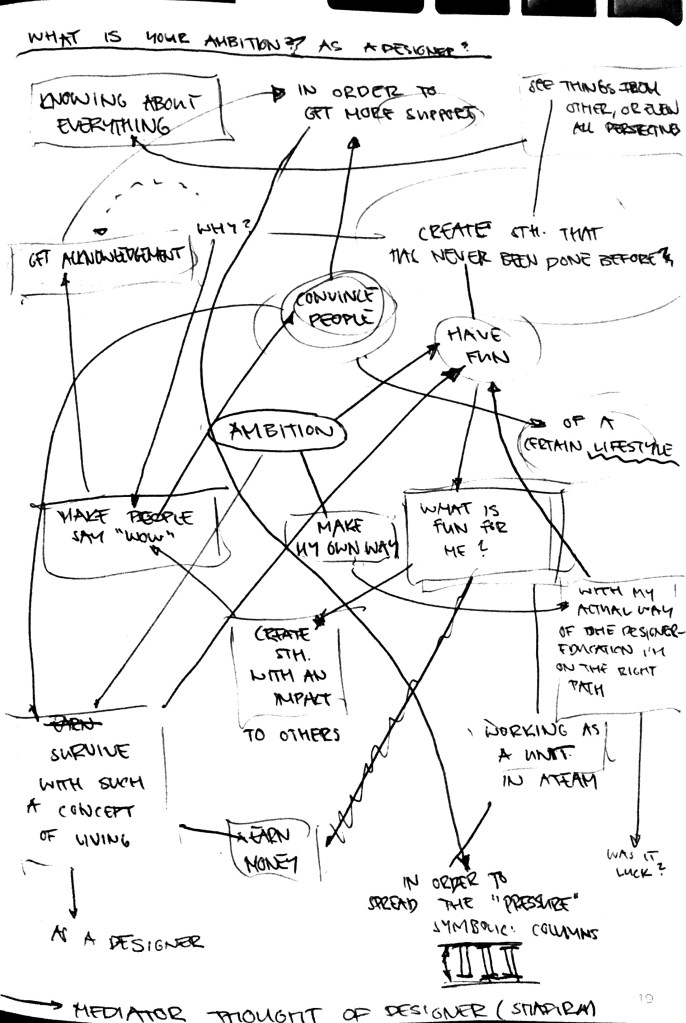
Because I knew that this question is not possible to answer with a text (with word after another word) I created a MindMap which enabled me to think about it in more than just a one dimensional, linear way.

Since for me the description of a designer is very broad (after two years of studying design), I tried to not only to comment on the design discipline itself, but rather how I see myself in the future and what drives me to get there. After doing this task and hearing others commenting their findings in the round, I once again realised that I am pretty satisfied with where I am standing at right now and what I study.

Concerning my future “design” career I asked myself what my ambition is in the projects I want to do. The first thing I wrote is “having fun”. I think it is very clear to me, that being a designer cannot be a nine to five job. Thats why it is very important to do jobs, that makes fun (but of course also finances my life to a certain extend).

I think everybody’s ambition is to create something with impact, but I really tried to figure out what this means to me. Is it only to get acknowledgement from people? This i’m still not really sure about myself. What I’m pretty certain is, that I cannot do things only for myself. Projects need to be in connection with people, is it in the process (working in a team) or in the usage of the design.

A crucial thing about myself is the aim for experience and knowledge. I would describe myself an observer and explorer, who always tries to find new ways, recombination of things in order to create something new. This is for sure something I never want to loose in my life.

Question/Task 3: Pick a topic, where you can say something, that no one ever has heard before

My topic/thoughts:

Why is there no graveyard for digital data?
We people own digital data as if it is real objects (which they basically are, but we perceive them differently). But what happens to our personal belongings in the digital space? Obviously if one has a hard drive with stored data on it, other people can read it. But especially in a time of security and privacy, data access gets more and more restricted to the owners.
Since death is (mostly) a unpredictable event, many people do not define what happens with their belongings after and if they do, they do not care about the digital space.

This is a topic, that crossed my mind several times the last few months, when I was moving to a new flat and needed to change the addresses in various digital platforms (bank accounts, insurances etc). At the same time, I try to figure out the best way to organise my data on my hard drives and passwords. So far, I’ve never heard of this combination of a inheritance in digital space.

Session 02 – Inter-Action

Living means doing actions. As soon as we’re doing something in our environment we’re not only acting in it, but also interacting with it. But what does the word “inter” add to the term, that describes our field of study. In the following paragraph, i want to think about, how others took action through interaction, but also what describes my very personal connection to it.

The call to take action

When multiple individuals want to follow a common goal, they often need to join forces in order to have an impact. More people means more power and therefore equals in more impact on a society. When such a mechanism happens one can speak of a movement. While researching, i came upon two movements, that seem interesting to me, because they show very well, how broad interaction can be understood.

MAD – Make a Difference

poster for the back-a-thon protest

Make a difference is a non-profit organisation, which follows the goal of ensuring equitable outcomes for children in India. The organisation adresses the need of 35 million children, who are in need of care and protection, especially orphans in shelter homes. (makeadiff.in). To make aware of this need, the organisation call for a peaceful protest called back-a-thon in multiple cities across india. As the name already mentions, all protesters are supposed to walk backwards.

I think it is very interesting to see, how such simple rule in a protest can form a feeling of community of the protesters. Also it is a nice way, to create an individual protest, that can be separated from others through such action.

Streetparade 92′

first streetparade flyer in Zurich from 1992

A more local movement from Zurich I stumbled over in my research is the streetparade, a demonstration for love, peace, liberty, generosity and tolerance. This event was organised along the lines of the loveparade, that was initiated three months before in Berlin, Germany. Three years after the fall of the Berlin wall, people wanted to celebrate more unity and diversity. Electronic Music was a big part of the parades and still is. The Zurich streeparade is till now a yearly event and is nowadays, besides the city fesitval, one of the biggest events in the city of zurich.

This event shows very well to me, that people can also protest in a very peaceful way by just taking action together. I think it is a nice way to actively demonstrate and propose solutions to other people, instead of blaming them aggressively. Though, one can ask how big the influence such an event has to a society, especially since the event has gained many commercial aspects over time.

Personal intersectionality to Interaction

[work in progress]

Why do I act, where do I create intersections? What is my very individual mindset, that leads me to the way i take actions, and therefore interact?

my individual mindmap

Session 01 – What does it mean to take action?

The world is in constant movement and change – and so are we. As designers, influencing our surrounding can be seen as a main tool of our work. But how do we achieve change, what does it mean to take action? In our first meeting with my classmates of the fifth semester of interaction design, we tried to figure out, what things in the past years had a big impact on us, and where we did actions that had an impact on others.

What made an impact to me the past two years?

It’s not surprising, that two years of study changed the way I think (would be a pity if it didn’t). One thing I realised some month ago was, when I had an intensive talk with the one of my best friends; It was one of these moments, where I clearly would have had to support her in her opinion, just to be a good friend and show empathy. But I just couldn’t because I tried to also see the other peoples’ perspective. That is where I recognised how the approach of objectivity, which we are taught in various design theory lessons, influences my daily thinking and also my actions. I personally really like to see things through an objective lens (as much objective as possible as an individual), because I think it helps so much contextualise and understand relations. But though, this experience lead my to ask myself: Am I even able to have my own opinion anymore? Am I allowed to have a gut feeling as a designer? Or am I damned to always find the best solution for everyone involved?

As my colleague Pascal mentioned in the discussion, the acquired skill of coding had also a big impact on my thinking. In my opinion the logical and systematic way of seeing problems even enhanced the notion of being objective all the time.

Where did I have an impact to others?

Talking a lot with my friends about my study (which is as mentioned in the paragraph above not only my school life but also takes in much space in my private life) and design in general changed the way they see design. Showing them the strengths and abilities of (interaction) design broadened their perspective towards design . That’s why some friends are considering to study design (or even interaction design). I think since the question of “what do you study” or “what is interaction design” cannot be answered in one sentence, a lot of discussions arose which the ended up in very philosophical, world view changing discussions. That’s where I see my contribution to others actions.

What is a contribution?

In my opinion, contribution is initialising change. In order to do that, tools are needed. It is a designers task to create such tools. While doing that, he/she often makes use of already existing tools and techniques.

Teaching

In our last session we talked about teaching. It is important to not only consume knowledge but also let others benefit of your skills. Today, every participant brought one skill to teach to other classmates. In my group (of four people) we taught each other several things: some words of the Hungarian language, a relaxation technique, some words of the Tibetan language and how to fold a three dimensional cube out of paper. Each skill was limited to 5 minutes of explanation and practicing.

Findings while teaching and learning

I taught how to fold a three dimensional cube out of paper. It was interesting to see others struggling with a process that was so clear to me. I tried to explain things more slowly with repetitions in order that the others better understand.

Design a site like this with WordPress.com
Get started